eCOCO2
Direct electrocatalytic conversion of CO2 into chemical energy carriers in a co-ionic membrane reactor
Despite the potential benefits of converting CO2 to fuel, current technologies face significant challenges that hinder their industrial implementation. Typically, these processes require multiple steps and incur in high capital and operational costs. Furthermore, multiple steps and unfavourable thermodynamics make these technologies energy-intensive, with efficiencies of around 60%.
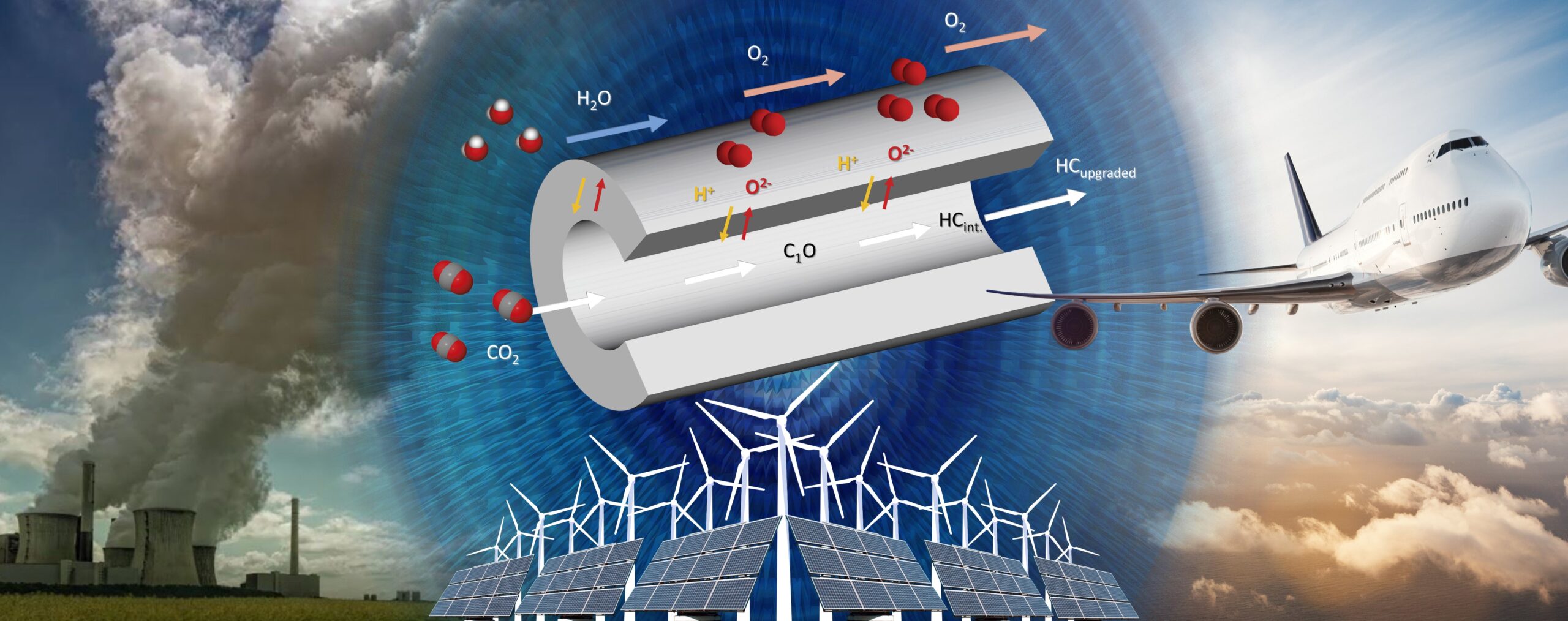
One promising solution to reduce costs and improve energy efficiency is process intensification using membrane reactors, multifunctional units combining a chemical reaction with a membrane-based separation. Another approach successfully applied within process engineering to achieve process intensification is using electrochemical reactors that give the chance to use electric power to supply the energy required by a chemical reaction and to do it with high selectivity. Both concepts can be combined in an electrochemical membrane reactor, with the transport of substances controlled by galvanic operation. Electrochemical reactors use ion-selective membrane electrolytes to separate anodic and cathodic reactions.
EcoCO2 project aims to leverage the advantages of electrochemical processes, membrane reactors, and advanced multi-step catalysis to set up an innovative electrocatalytic co-ionic membrane reactor for the single-step conversion of CO2, using renewable electricity and water steam, to carbon-neutral synthetic liquid fuels for their use as transport fuel, and in particular as jet fuel, at high energy efficiency, very high CO2 conversion rate and moderate-to-low cost.
The EcoCO2 project is a collaborative endeavour, bringing together 12 partners from 8 European countries financed by the EU under the H2020-LC-SC3-2018-NZE-C.