
2023
- Serra, J. M., et al. “Modulating redox properties of solid-state ion-conducting materials using microwave irradiation.” Materials Horizons 10.12 (2023): 5796-5804.
- Dilissen, Nicole, et al. “Temperature dependency of the dielectric properties of hydrated and ordinary Portland cement and their constituent phases at 2.45 GHz up to 1100° C.” Cement and Concrete Research 165 (2023): 107067.
- Kwak, Yeonsu, et al. “Microwave-assisted, performance-advantaged electrification of propane dehydrogenation.” Science Advances 9.37 (2023).
- Vicente-Jurado, Diana, et al. “Effect of Extrusion Compression Ratio and Particle Size of Rice on the Sectional Expansion Index of Third-Generation Snacks.” Biology and Life Sciences Forum. Vol. 26. No. 1. MDPI, 2023.
- Sánchez, Juan R., et al. “Microwave calorimeter for dielectric and thermal analysis of materials.” Energy 263 (2023): 125909.
- Paradisi, Enrico, et al. “On the use of microwaves during combustion/calcination of N-doped TiO2 precursor: An EMW absorption study combined with TGA-DSC-FTIR results.” Materials Letters 338 (2023): 133975.
- García-Baños, Beatriz, et al. “Evaluation of microwave synthesis of ceramic pigments based on in situ dielectric characterization.” Materials 16.8 (2023): 2976.
- Selvam, Esun, et al. “Plastic waste upgrade to olefins via mild slurry microwave pyrolysis over solid acids.” Chemical Engineering Journal 454 (2023): 140332.
- Baker-Fales, Montgomery, et al. “Temperature-dependent complex dielectric permittivity: a simple measurement strategy for liquid-phase samples.” Scientific Reports 13.1 (2023): 18171.
- López-García, Andrés, et al. “Microwave-Driven Exsolution of Ni Nanoparticles in A-Site Deficient Perovskites.” ACS nano 17.23 (2023): 23955-23964.
- Pérez-Botella, Eduardo, et al. “Challenges in the microwave heating of structured carbon adsorbents.” Chemical Engineering Journal 476 (2023): 146632.
- Moratal, Sheila, et al. “Fast-low temperature microwave sintering of ZrSiO4–ZrO2 composites.” Ceramics International 49.13 (2023): 21652-21657.
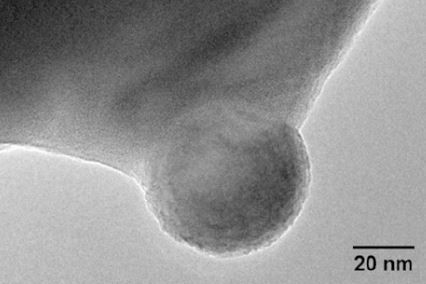
We demonstrate the exsolution of catalytically active Ni nanoparticles driven by microwaves in the absence of hydrogen or low pressures.
With the aid of microwaves, we were able to generate these exsolved nanoparticles at milder temperatures and shorter exposure times than conventional thermal exsolution.