MERIT
Green hydrogen using microwave technology via advanced materials
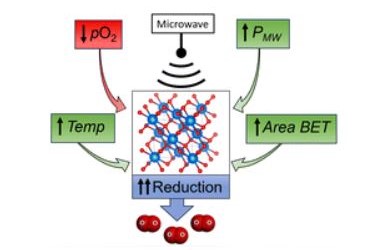
MERIT project aims to develop fundamental understanding to produce green hydrogen from water by taking advantage of the microwave-driven enhancement of the reduction-oxidation (redox) reactions of solid-state ionic materials (SSIM) at unprecedented mild temperatures (≈ 400 °C). This novel electrochemical water splitting route, delivering just O2 as a by-product, entails a promising opportunity for sustainable, carbon-free H2 production, with projected low energetic costs and high efficiency
The physical principle behind MERIT is based on the induced reduction of selected solid-state materials triggered by microwave irradiation, which promotes the generation of vacancies in the crystal lattice and O2 release.
One of the main singularities of this microwave electromagnetic radiation stems from the unique way it interacts with matter, particularly with SSIM. Microwave energy is directly transferred to the material through the induced excitations on their dipolar and ionic constituents. The exploitation of this property implies the non-contact activation of target molecules in selected SSIMs, being of special interest to those able to generate oxygen vacancies and prompt the H2 generation chain process. Moreover, this type of interaction carries additional inherent advantages. Firstly, eliminating any intermediate step implies simpler equipment than other technologies, namely electrolysers, eliminating the need for cables, electrodes or membranes. Secondly, lacking contact transfer mechanisms avoids inherent potential energy losses, e.g. in conventional thermal heating methods. Indeed, the efficiency of a well-controlled microwave-driven process is only pondered by the SSIM and its ability to absorb the supplied microwave energy, considering that the rest of constituent elements are transparent to this type of radiation.
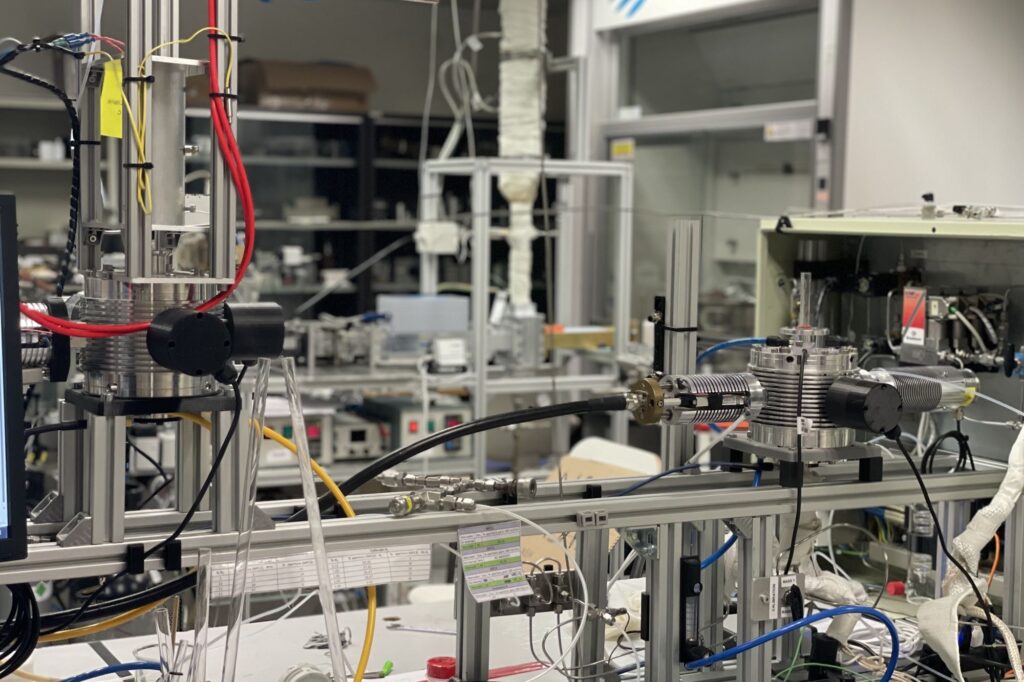
Experimental setup
In this three-year project, ITACA-DIMAS team will be supported by relevant research groups to study and optimize the formulation and morphology of SSIM for optimal microwave processing. This collaboration will primarily involve the Energy Conversion and Storage group at the Institute of Chemical Technology (ITQ) and the Nanostructured Films & Particles Research Group (NFP) at the Institute of Nanoscience of Aragon (INA).