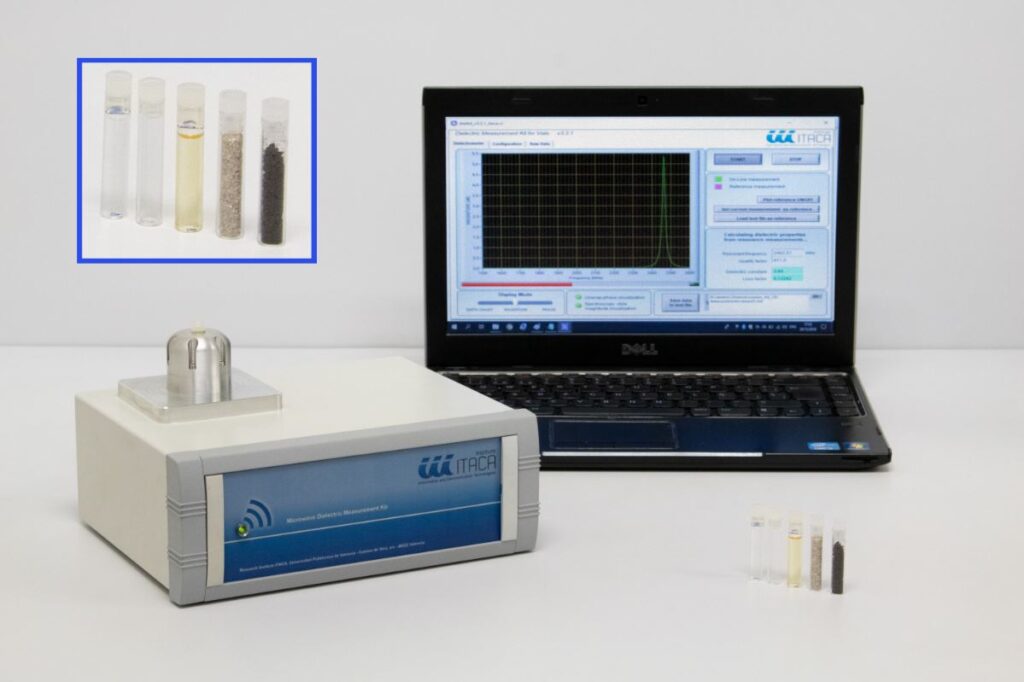
Measurement of dielectric properties
Dielectric properties are fundamental parameters that define how a material interacts with a microwave field, and therefore they are essential parameters for designing wireless devices, sensors and microwave processing systems.
To meet the growing demand for fast and accurate measurements and with our experience in measuring the complex permittivity of over hundreds of samples per year, ITACA-DIMAS offers highly precise and reliable dielectric measurement services by utilizing the most suitable measurement techniques according to the material specifications (material type, size, shape, frequency, temperature, etc.).
Dielectric properties can be correlated with properties such: moisture content, density, chemical reaction, structure, curing, bacterial content, etc.
ITACA-DIMAS also offers cost-effective stand-alone highly precise dielectric measurement systems for different types of materials. (see bespoke MW equipment section)
The different methods used for dielectric measurements are described next:
Microwave Cavities and Resonators

The measurement of dielectric properties using microwave cavity or resonant methods are based on the measurement of the resonance parameters (resonant frequency and Q-factor) of a microwave cavity or resonator containing a sample of a material under test (MUT).
Resonant methods offer higher accuracy for both low and high loss materials, but they are constrained to narrow frequency ranges, typically centered around the resonant frequencies of the cavity or resonator. An additional advantage of resonators is that they can be designed to accommodate smaller samples, reducing the amount of material required for testing.
MW-DETA
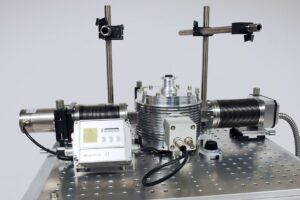
MW-DETA is an innovative device and methodology engineered to measure the temperature-dependent variations of dielectric properties of materials at microwave frequencies with the simultaneous application of microwave irradiation.
The MW-DETA is designed in an 105dx85h mm dual-mode cylindrical cavity reactor, featuring two non-interfering, distinct swept-frequency microwave sources. The TE111 mode near 2.45 GHz is used to heat an approximate 15x10mm sample with high-power microwaves, while the TM010 mode around 2.1 GHz measures dielectric properties as a function of temperature.
Open-ended Coaxial Probes
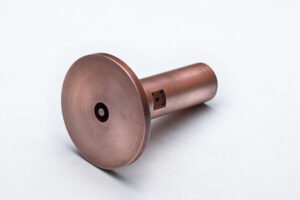
The open-ended coaxial probe is a cut-off section of a coaxial transmission line with an optional extension of the ground plane or flange. The material is measured by immersing the coaxial probe into a liquid/semiliquid or in direct contact with the flat surface of a solid/powder material.
The fields at the probe change as they interact with the MUT and the reflection at the coaxial/sample interface, measured by a VNA, are related to the complex permittivity of the sample by solving the maxwell equations at the aperture (assuming non-magnetic materials).
Microwave Microscope
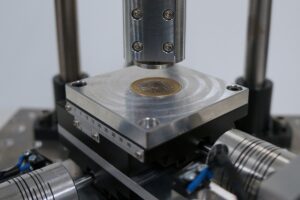
The microwave microscope employs a small probe that scans the material’s surface, with the microwave signal being sensitive to variations in the dielectric properties at a microscopic scale. As the probe moves across the surface, it measures changes in the amplitude and phase of the reflected or transmitted microwave signal. Perturbational theory provides the mathematical framework to interpret these changes, allowing for the quantification of the material’s dielectric properties.
This approach enables high-resolution, non-destructive testing of the dielectric properties, making it invaluable for applications in material science, electronics, and nanotechnology.