
2021
- Chen, Weiqi, et al. “Intensified microwave-assisted heterogeneous catalytic reactors for sustainable chemical manufacturing.” Chemical Engineering Journal 420 (2021): 130476.
- Malhotra, Abhinav, et al. “Temperature homogeneity under selective and localized microwave heating in structured flow reactors.” Industrial & Engineering Chemistry Research 60.18 (2021): 6835-6847.
- Lagunas-Chavarría, A., et al. “Effect of synthesis and sintering temperatures on K0. 5Na0. 5NbO3 lead-free piezoelectric ceramics by microwave heating.” Journal of Materials Science: Materials in Electronics 32.11 (2021): 15279-15290.
- Guillén Pineda, René M., et al. “Fabrication and characterization of Nb2O5‐doped 3Y‐TZP materials sintered by microwave technology.” International Journal of Applied Ceramic Technology 18.6 (2021): 2033-2044.
- Gutiérrez-Cano, José D., et al. “Detection of anti-counterfeiting markers through permittivity maps using a micrometer scale near field scanning microwave microscope.” Sensors 21.16 (2021): 5463.
- Penaranda-Foix, Felipe L., et al. “Directional coupler calibration for accurate online incident power measurements.” IEEE Microwave and Wireless Components Letters 31.6 (2021): 624-627.
- Guillen, Rene M., et al. “Dielectric, mechanical and thermal properties of ZrO2–TiO2 materials obtained by microwave sintering at low temperature.” Ceramics International 47.19 (2021): 27334-27341.
- Moratal, Sheila, et al. “Study of colored on the microwave sintering behavior of dental zirconia ceramics.” Journal of Asian Ceramic Societies 9.1 (2021): 188-196.
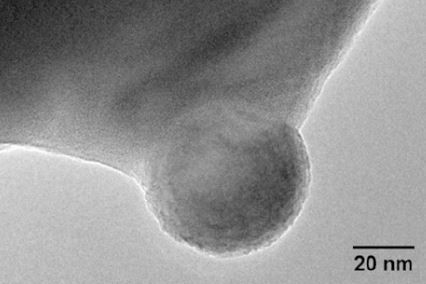
We demonstrate the exsolution of catalytically active Ni nanoparticles driven by microwaves in the absence of hydrogen or low pressures.
With the aid of microwaves, we were able to generate these exsolved nanoparticles at milder temperatures and shorter exposure times than conventional thermal exsolution.