Hydrogen production via microwave-induced water splitting (Nature Energy, 2020)
Explore a revolutionary method to produce Hydrogen in our paper, “Hydrogen production via microwave-induced water splitting at low temperature,” published in November 2020 in Nature Energy.
Supplying global energy demand with CO2-free technologies is becoming feasible thanks to the rising affordability of renewable resources. Hydrogen is a promising vector in the decarbonization of energy systems, but more efficient and scalable synthesis is required to enable its widespread deployment.
In this research paper we report contactless H2 production via water electrolysis mediated by the microwave-triggered redox activation of solid-state ionic materials at low temperatures (<250 °C). Water was reduced via reaction with non-equilibrium gadolinium-doped CeO2 that was previously in situ electrochemically deoxygenated by the sole application of microwaves. The microwave-driven reduction was identified by an instantaneous electrical conductivity rise and O2 release. This process was cyclable, whereas H2 yield and energy efficiency were material- and power-dependent.
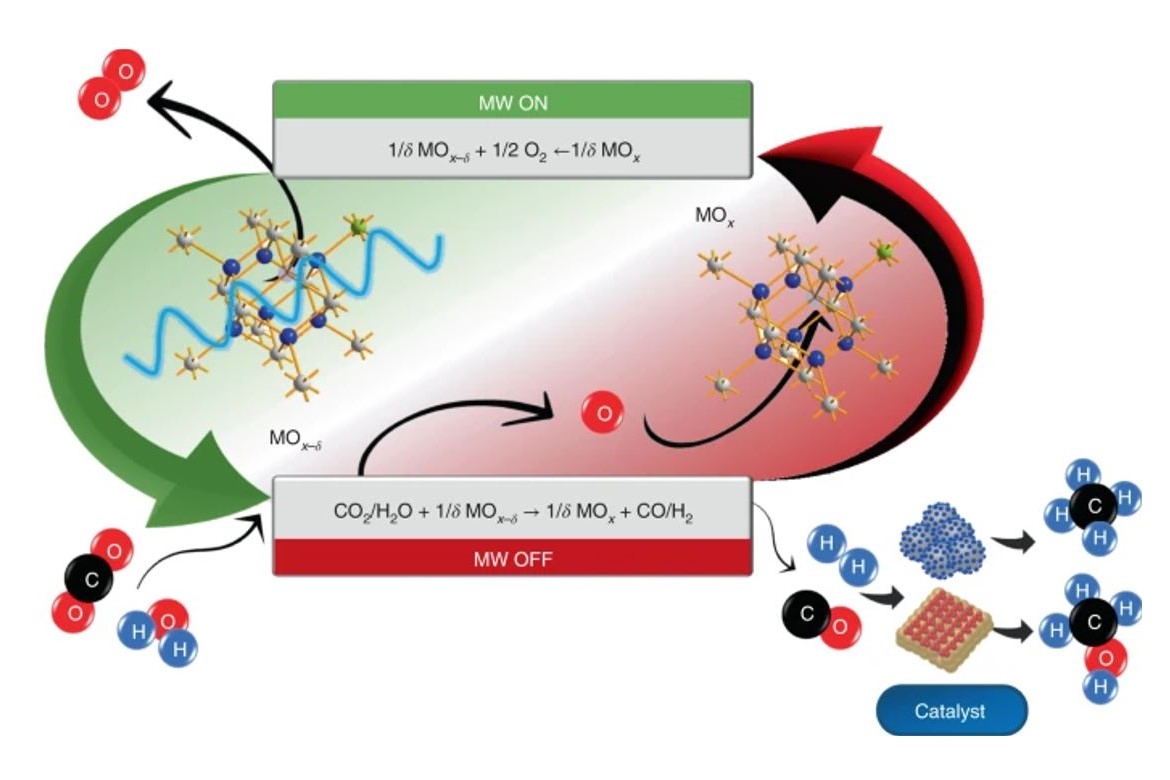
Furthermore, the proposed technology can be coupled to produce different hydrocarbons or other molecular energy carriers, for example, the reported CH4 formation from CO2 and H2O integrated in a Sabatier reactor over a Ru/γ-Al2O3-catalyst.
This method enables the contactless, electrolyte-free realization of electrochemical reactions such as H2O electrolysis, alleviating the operational constraints of classical electrochemical cells (that is, the temperature, pressure and reactor-stack architecture will not be restricted by the electrolyte/electrode operation window and challenging electric contacting). Reduction of compounds based on anions other than O2– (for example, S2–, Cl–, Br–) will allow for new chemistries, with application in several sectors such as emission control and functionalization of hard-to-activate molecules at low temperatures. Electricity storage is another pivotal application, facilitating ultrafast battery recharge through volumetric reduction of anode-chamber materials. Tighter control of reduction energetics (electric work and reduction/reoxidation enthalpies) through material formulation and microwave-process engineering will maximize energy efficiency and operability in very diverse areas.