MW Heating

DESTINY

Development of an Efficient Microwave System for Material Transformation in energy INtensive processes for an improved Yield

The DESTINY project pursues to realize a functional, green and energy saving, scalable and replicable solution, employing microwave energy for continuous material processing in energy-intensive industries. The target is to develop and demonstrate a new concept of firing for granular feedstock to realize material transformation using full microwave heating as alternative energy source and complement to the existing conventional production.

With 14 partners covering 9 European countries and financed by the EU H2020 research and innovation programme, the DESTINY system is conceived as cellular kilns in a mobile modular plant, with significant advantages in terms of resource and energy efficiency, flexibility, replicability, scalability, and a reduced environmental footprint. Availing of the DESTINY solution’s capability to enhance process stability and efficiency, and given the characteristics of the used raw materials, DESTINY project will investigate intermediate/sub/final products to improve the performance of processes within 3 industrial sectors (Cement, Ceramics and Steel). New heating technologies, monitoring systems and numerical simulation tools will be used to drive the design of large-scale applicators and excel in the outcome.

Experimental results demonstrated that microwave energy leads to an unprecedented 30% increase of the process efficiency, resulting in a remarkable decrease of the CO2 emissions in the considered sectors. The application of this technology can contribute to transform the traditional manufacturing, based on fossil fuels and with a low control of the processing parameters, into a completely new flexible, compact, eco-friendly and smart factory concept.


 

DESTINY Read More »

H2MW

Development of a pilot plant for green hydrogen production using microwave technology

The H2MW Project aims to develop a pilot plant for green hydrogen production using microwave technology. This groundbreaking advancement leverages the reduction of Solid-State Ionic Materials (SSIM) by microwaves at significantly lower temperatures compared to conventional methods.

The project’s objective is to design and construct a technological demonstrator that will serve as a foundation for future industrial-scale devices. This meticulous approach will evaluate and consolidate Key Performance Indicators (KPIs), and develop scalable models, ensuring a robust and successful outcome.

This innovative electrochemical water dissociation process, producing only O₂ as a byproduct, offers a promising pathway for sustainable, carbon-free hydrogen production with low energy costs and high efficiency.

This 2-year project will be a joint effort by the Microwave Division (DIMAS) of the ITACA Institute at UPV, the Energy Conversion and Storage group at the Institute of Chemical Technology (CSIC-ITQ), and the engineering and technology group Sener.

H2MW Read More »

RHINO

Electrifying chemistry towards net-zero emission industry

The RHINO project aims to establish a new electrified paradigm for the chemical industry that incorporates renewable energy sources and decarbonizes this energy-intensive sector. This paradigm shift has the potential to significantly reduce the industry’s carbon footprint, increase energy efficiency, and enhance the production of high-value chemicals, thereby contributing to a more sustainable and competitive chemical industry. 

The core of RHINO’s strategy is the development of electrochemical reactors that use electric power to drive chemical reactions with high selectivity. The project seeks to overcome current barriers by creating a new class of electrified catalytic reactors through an interdisciplinary approach. This approach combines cutting-edge nanomaterials, interface engineering,a deep understanding of reaction kinetics, microwave engineering, and advanced multi-physics modelling.

RHINO will focus on developing two innovative types of electrically driven reactors:

Electrochemical Membrane Reactor Technology. Two approaches for the electrification of membrane reactions are tackled. On the one hand, Joule electric heating in ceramic membrane reactors will allow exploiting the effect of local heating. On the other hand, electrochemical reactors based on membrane electrode assemblies (MEA) will be developed. 
Microwave-Driven Enhanced Catalysis: This breakthrough technology will employ microwave (MW) electromagnetic irradiation to enhance the catalysis of reduction-oxidation (redox) reactions. MW irradiation allows for processing at lower reaction times and temperatures, improving energy efficiency and selectivity. The concept of “non-equilibrium local heating”—where specific domains are heated to much higher temperatures than the bulk solution—will be explored to enhance chemical reactions. 

The project is led by two Spanish research groups at the forefront of microwave technology (Microwave Division of ITACA Institute -ITACA-DIMAS-) and catalytic materials research (Energy Conversion and Storage group at the Institute of Chemical Technology -CSIC-ITQ-). With a focus on multidisciplinary activities, both partners will collaborate in this 2-year project -from December 2022 to November 2024- to pave the way for a sustainable future in the chemical industry by developing advanced electrified processes that align with sustainable development goals.


RHINO Read More »

RASMIA

Towards sustainable energy processes in chemical industry: development of CO2 capture and utilization assisted by microwave heating

RASMIA project entails the transformation of energy intensive chemical industry through microwave heating, a more efficient way of supplying energy to the processes using renewable electricity and avoiding fossil fuels.

This coordinated project, financed by the Spanish Science and Innovation Ministry (PID2022-138336OB-C21) will focus on the design of new microwave driven processes for CO2 capture and hydrogen generation by Dry Reforming of Methane (DRM). The goal is to contribute to decarbonisation of chemical industry together with process circularity, since the CO2 captured in the microwave adsorption process constitutes the raw material for dry methane reforming.

RASMIA involves researchers from the Institute of Information and Communication Technologies (ITACA) of the Universitat Politècnica de València (UPV), belonging to the Microwave Division (ITACA-DIMAS). The coordination of the project is led by researchers from Universidad de Zaragoza (UNIZAR), Instituto de Nanociencia y Materiales de Aragón, INMA, working in the field of Chemical Engineering and Materials Science.

Continuous evaluation of the results throughout the project will direct RASMIA’s efforts towards optimizing resource efficiency, process scalability, and reducing the cost and carbon footprint compared to the state-of-the-art reference processes of amine absorption for CO2 capture and steam reforming for syngas production.

RASMIA Read More »

eCOCO2

Direct electrocatalytic conversion of CO2 into chemical energy carriers in a co-ionic membrane reactor

Despite the potential benefits of converting CO2 to fuel, current technologies face significant challenges that hinder their industrial implementation. Typically, these processes require multiple steps and incur in high capital and operational costs. Furthermore, multiple steps and unfavourable thermodynamics make these technologies energy-intensive, with efficiencies of around 60%.

One promising solution to reduce costs and improve energy efficiency is process intensification using membrane reactors, multifunctional units combining a chemical reaction with a membrane-based separation. Another approach successfully applied within process engineering to achieve process intensification is using electrochemical reactors that give the chance to use electric power to supply the energy required by a chemical reaction and to do it with high selectivity. Both concepts can be combined in an electrochemical membrane reactor, with the transport of substances controlled by galvanic operation. Electrochemical reactors use ion-selective membrane electrolytes to separate anodic and cathodic reactions.

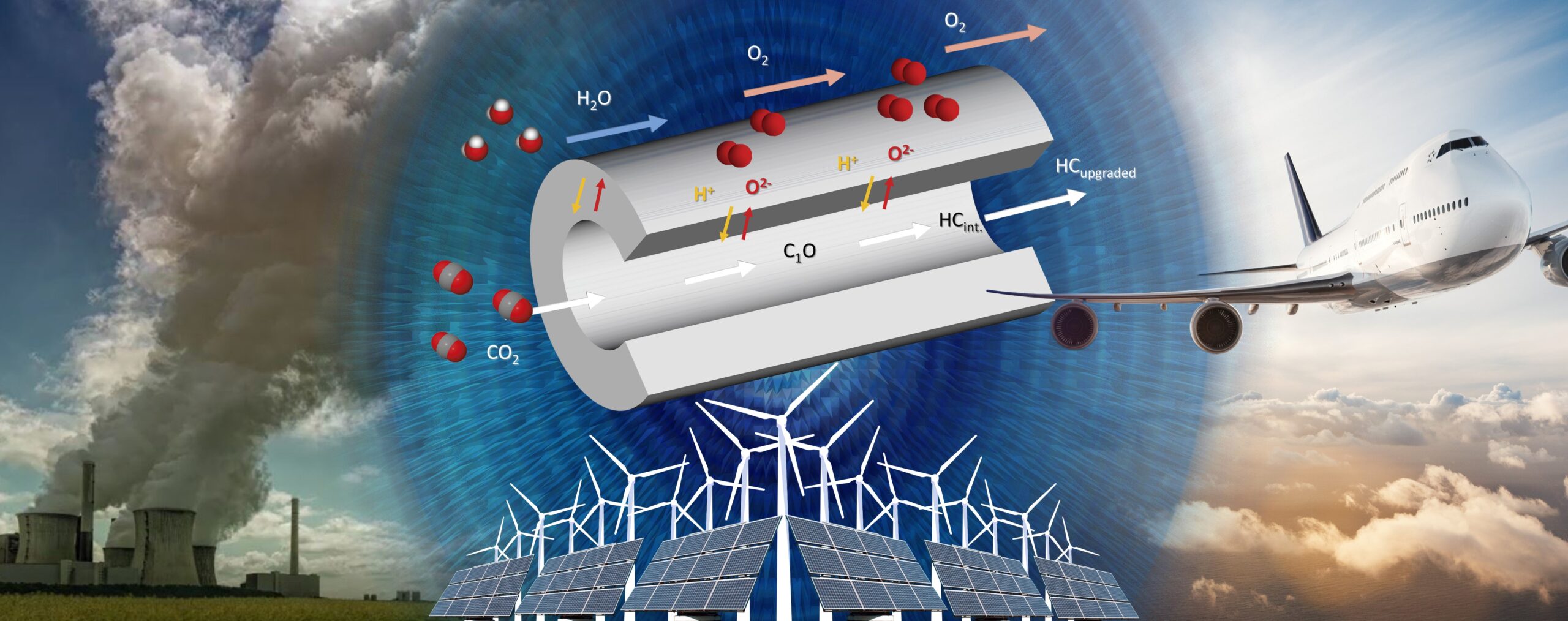
EcoCO2 project aims to leverage the advantages of electrochemical processes, membrane reactors, and advanced multi-step catalysis to set up an innovative electrocatalytic co-ionic membrane reactor for the single-step conversion of CO2, using renewable electricity and water steam, to carbon-neutral synthetic liquid fuels for their use as transport fuel, and in particular as jet fuel, at high energy efficiency, very high CO2 conversion rate and moderate-to-low cost.

The EcoCO2 project is a collaborative endeavour, bringing together 12 partners from 8 European countries financed by the EU under the H2020-LC-SC3-2018-NZE-C.

eCOCO2 Read More »

Scroll to Top