News

Mineral Detection by Microwave Microscopy (Sensors, 2022)

Take a look at our new development for the characterization of rocks published in the paper ‘High-Resolution Detection of Rock-Forming Minerals by Permittivity Measurements with a Near-Field Scanning Microwave Microscope,’ available since January 2022 in Sensors.

Our research introduces a portable near-field scanning microwave microscope (NSMM) that allows non-invasive and non-contact measurements of the permittivity maps of rocks, which is probably the most relevant parameter needed to develop more efficient, fast, and eco-friendly microwave-based processes in the rock industry. …

Mineral Detection by Microwave Microscopy (Sensors, 2022) Read More »
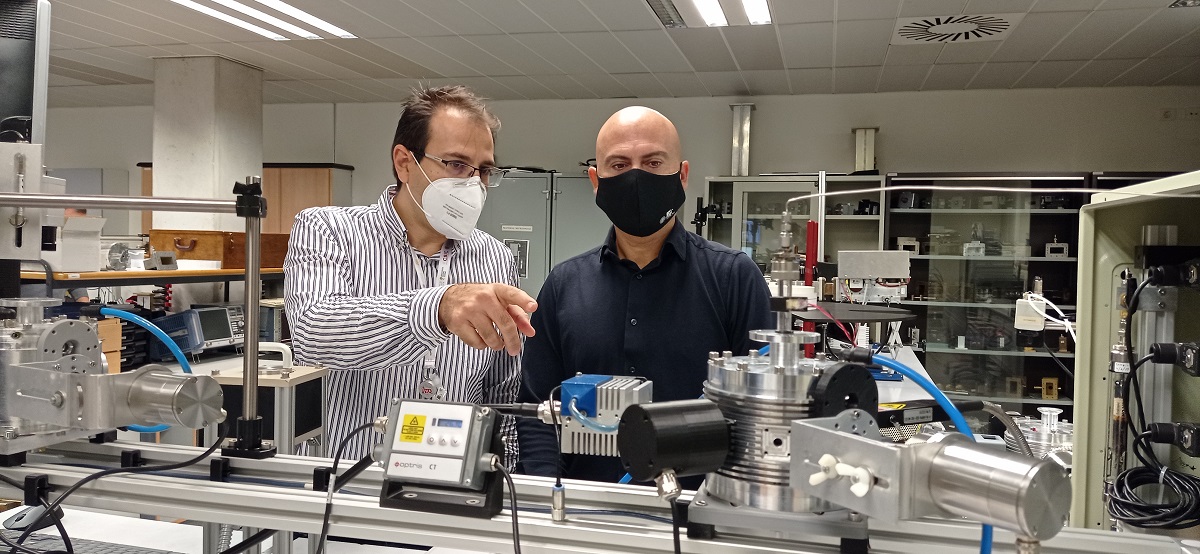
Measurement of Dielectric Properties at temperatures up to 350ºC with DKV

The use of microwaves in fields as communications, radar, medicine, biology, agriculture and industrial processes demands accurate knowledge of the dielectric properties of materials and its variations with respect to many factors.

In particular, monitoring variations of materials dielectric properties with temperature is crucial for many applications, in which it is important to predict the materials performance over the whole working temperature range.

In order to provide a suitable technique, the Dielectric Kit for Vials has been equipped with the necessary components for the dielectric characterization of materials up to 350ºC. …

Measurement of Dielectric Properties at temperatures up to 350ºC with DKV Read More »

New insights in microwave-driven redox transformations (Materials Horizons, 2023)

We are pleased to present the scientific work “Modulating redox properties of solid-state ion-conducting materials using microwave irradiation“, published in October 2023 in Materials Horizons, a Royal Society of Chemistry publication.  

The research addresses the industrial demand for efficient, low-carbon technologies by exploring additional significant findings from our laboratory regarding the recently discovered use of microwaves as an effective reducing agent for solid-state ion-conducting materials (SSIMs), holding promise for various applications, including gas depuration, energy storage, and hydrogen generation.   

The study examines the dynamics and physicochemical dependencies of microwave-induced redox transformations in materials such as gadolinium-doped ceria (CGO) and yttria-stabilized zirconia (8YSZ). Microwave processing promotes oxygen-vacancy formation and oxygen-surface exchange at significantly lower temperatures than traditional techniques.   

New insights in microwave-driven redox transformations (Materials Horizons, 2023) Read More »

A revolution in energy research, from microwaves to hydrogen

The technology developed by researchers from the ITACA and ITQ institutes makes it possible to transform electric energy into hydrogen or chemical products, solely using microwaves.

A team of researchers from the Polytechnic University of Valencia and the Spanish National Research Council (CSIC) has discovered a new method that makes it possible to transform electricity into hydrogen or chemical products solely using microwaves – without cables and without any type of contact with electrodes.

This represents a revolution in the field of energy research and a key development for the process of industrial decarbonisation, as well as for the future of the automotive sector and the chemical industry, among many others. The study has been published in the latest edition of Nature Energy, where the discovery is explained.

A revolution in energy research, from microwaves to hydrogen Read More »

Microwave-driven exsolution (ACS nano, 2023)

Discover the innovative approach to creating metallic nanoparticles with our latest study, ” Microwave-Driven Exsolution of Ni Nanoparticles in A-Site Deficient Perovskites,” published in November 2023 in ACS Nano, American Chemical Society.

Exsolution has emerged as a promising method for generating metallic nanoparticles, surpassing traditional deposition methods such as impregnation in terms of robustness and stability.

Here, we demonstrate the exsolution of catalytically active Ni nanoparticles driven by microwaves in the absence of hydrogen or low pressures. With the aid of microwaves, we were able to generate these exsolved nanoparticles at milder temperatures and shorter exposure times than conventional thermal exsolution.

Microwave-driven exsolution (ACS nano, 2023) Read More »

Scroll to Top