José Manuel Catalá

Hydrogen production via microwave-induced water splitting (Nature Energy, 2020)

Explore a revolutionary method to produce Hydrogen in our paper, “Hydrogen production via microwave-induced water splitting at low temperature,” published in November 2020 in Nature Energy.

Supplying global energy demand with CO2-free technologies is becoming feasible thanks to the rising affordability of renewable resources. Hydrogen is a promising vector in the decarbonization of energy systems, but more efficient and scalable synthesis is required to enable its widespread deployment.

In this research paper we report contactless H2 production via water electrolysis mediated by the microwave-triggered redox activation of solid-state ionic materials at low temperatures (<250 °C). Water was reduced via reaction with non-equilibrium gadolinium-doped CeO2 that was previously in situ electrochemically deoxygenated by the sole application of microwaves. The microwave-driven reduction was identified by an instantaneous electrical conductivity rise and O2 release. This process was cyclable, whereas H2 yield and energy efficiency were material- and power-dependent. …

Hydrogen production via microwave-induced water splitting (Nature Energy, 2020) Read More »
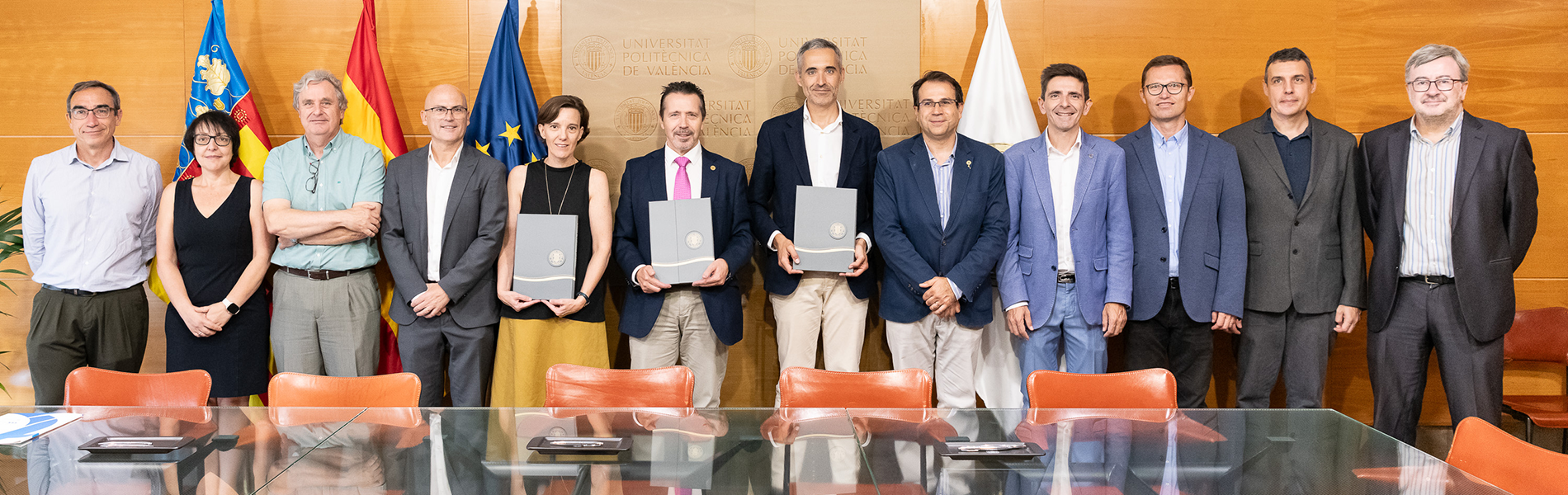
Pilot plant to generate green hydrogen using microwaves

UPV, CSIC and Sener sign an agreement to develop a pilot plant to generate green hydrogen using microwaves

The Universitat Politècnica de València (UPV), the Spanish National Research Council (CSIC), and the engineering and technology group Sener have signed an agreement today to develop a pilot plant for the generation of green hydrogen, based on a disruptive technology developed by a team of researchers from the UPV’s ITACA Institute and the Institute of Chemical Technology (ITQ, CSIC-UPV).

After almost ten years of collaborative research, the technology developed by this UPV and CSIC team makes it possible to generate green hydrogen using microwaves. This revolutionary breakthrough is based on the microwave reduction of solid materials at unusually low temperatures compared to other technologies and was published in 2020 in the journal Nature Energy.

Pilot plant to generate green hydrogen using microwaves Read More »

First quantitative microwave calorimeter (Energy, 2023)

We are happy to share our new research describing a novel application of microwave technology in the field of material analysis, “Microwave calorimeter for dielectric and thermal analysis of materials,” published in January 2023 in Energy (Elsevier).

Our article presents a unique method for microwave processing and measurement of dielectric and thermal properties of materials as a function of temperature.

The increasing energy demand has brought the advent of new materials with advanced properties, including the materials that generate, store and transport energy, along with new processing techniques (microwaves, solar energy, etc.). This type of material requires the development of new testing instruments and measurement methods capable of highlighting their unique properties and potential to store energy. …

First quantitative microwave calorimeter (Energy, 2023) Read More »

A stand-alone instrument for permittivity characterization inside tubes (IEEE TIM, 2019)

We are happy to share our new research describing a novel device for material characterization, “A new stand-alone microwave instrument for measuring the complex permittivity of materials at microwave frequencies,” published in September 2019 in IEEE Transactions on Instrumentation and Measurement.

The paper presents a portable, user-friendly, and standalone device for complex permittivity characterization, designed for ease of use by non-specialized personnel and versatility across various scenarios. …

A stand-alone instrument for permittivity characterization inside tubes (IEEE TIM, 2019) Read More »

Optimizing heating patterns of PET preforms with microwaves (Appl. Therm. Eng, 2022)

Explore our new method for heating PET preforms with microwave energy optimized for the blow moulding process in our latest study, ” Focusing dielectric slabs for the optimization of heating patterns in single mode microwave applicators,” published in November 2021 in Applied Thermal Engineering, Elsevier.

Heating PET preforms is a crucial step in the blow moulding process, which is the predominant technique for producing containers utilized in the packaging, transportation, and storage of beverages. This procedure requires heating a cylindrical PET preform to a flexible state before the blow moulding phase, ensuring that the resulting plastic bottles possess the necessary mechanical properties. In this process, the preform temperature profile is one of the critical parameters for manufacturing a bottle with the desirable mechanical strength.

In this study, a novel approach utilizing adjustable dielectric slabs has been introduced to act as near-field focusing elements inside a single-mode microwave applicator, aiming to modify the temperature profile of PET preforms during microwave heating. …

Optimizing heating patterns of PET preforms with microwaves (Appl. Therm. Eng, 2022) Read More »

Scroll to Top